Navigating with Orion
Orion is one of the benchmark constellations, one that you have probably heard of or seen even if you're not into astronomy or astrology (it's not in the zodiac). However, unlike Ursa Major, it is only visible through late fall and early spring, blocking it from those who do not wish to go outside during incredibly cold nights, at least up here in the northeast. If you do get a chance to see it, use it to your advantage! Its shape allows it to point to several other constellations that are out during the winter and spring, providing much use to stargazers, romantic or otherwise.
The most recognizable feature of Orion is probably its belt, which can be used as a sort of ruler to point to other stars. Assuming you're in the northern hemisphere, Orion should be standing straight up, with his belt above a little cloud. That cloud is the Orion Nebula, a cloud of gas about 1500 light years away, and you can see it with the naked eye!

Closeup of Orion's midsection

Messier 42, the Great Nebula, taken by me

Brightest star names for later reference
Following the belt to the right, you will end up at Aldebaran, the brightest star in Taurus, a bull that represented a sacred harvest ritual in Egypt and Jupiter's godly infidelity in Rome. Continuing on this line will take you to the Pleiades, a beautiful open (not gravitationally bound to each other) star cluster, the daughters of Pleione, supposedly turned into stars to escape a chasing Orion. It didn't really work though, did it?
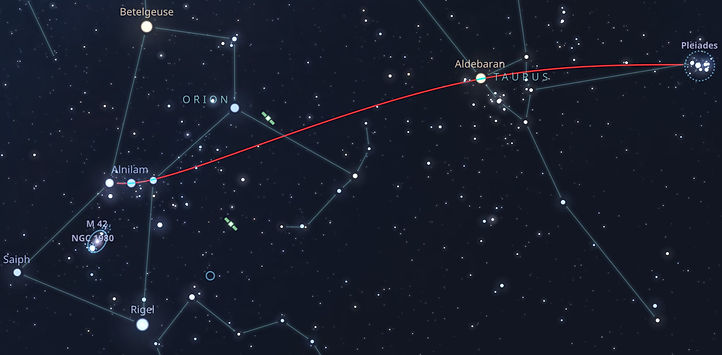

Taurus closeup (do not expect Mars to be there, planets move)

M45, the Seven Sisters, also taken by me
Going to the left instead will lead you to Sirius, the brightest star in the sky and of Canis Major, Orion's hunting dog, taken with him to be companions forever. At least that story's more wholesome!

If, instead of following the belt, you pass the line through Betelgeuse (top left), you will end up at Gemini, the twins brought to the stars through a noble act by Pollux to save his brother Castor.

Leaving the belt and using the stars instead, you can pass a line from Bellatrix (top right) through Betelgeuse and find Procyon, the brightest star in Canis Minor, the smaller dog Orion took with him into the afterlife. Continuing the line, you can end up at Cancer the crab, which Hercules killed in one of his twelve great labors. Going further still, you end up at Leo the lion, representing the Nemeon lion also slain by Hercules.

Going from Rigel (bottom right) up through Bellatrix, you will find Auriga, a confusing constellation with a few different mythologies, but mostly to reflect the Greeks' love for the chariot.

Finally, going from Saiph (bottom left) up through Bellatrix, you will end up at Perseus, the legendary Greek hero famed for slaying Medusa and first namesake of the best book series for middle school children.

Path

Perseus focus in Cherry Spring State Park, yet again taken by me