Navigating with Ursa Major
Despite having a whole page on finding north, I will stress one of those here because it's that helpful. Drawing a line between the two outermost stars of the Big Dipper (called Merak and Dubhe), then extending that line four times further than the original (in red), you will get close to Polaris, the star that denotes the celestial north pole, which leads almost directly north. Start with Merak, the one further away from the handle of the dipper. If you're ever lost in a forest or at sea, this will be crucial to know, but the Big Dipper is not always visible in the sky, which is why the Finding North section exists. Other bright stars are also named in the picture, but the important ones are at the bottom.

Cassiopeia
Ursa Major is visible throughout the year, so I'll start with it. The various lines that connect this constellation can be extended in a similar fashion to the Merak-Dubhe track, leading to all sorts of constellations around the sky. Starting with a familiar friend, the line connecting Merak and Dubhe can be extended past Polaris and lead to the another circumpolar constellation, Cassiopeia. This one is meant to represent a vain and arrogant queen in Greek mythology who believed she was more beautiful than all of Poseidon's daughters, calling upon his wrath and earning her an eternal chaining in the stars. To the rest of us, it looks like a W. This constellation is on the opposite side of Polaris as Ursa Major, so if the bear is at its highest in the sky (bowl of the dipper is upside down), Cassiopeia will be at its lowest. The best time to see Cassiopeia is when Ursa Major is at its lowest (dipper is upright) or on its side to see both constellations.
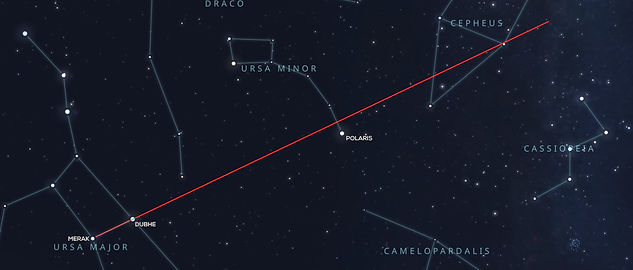
Image created with Stellarium web

The rest of the constellations derived from Ursa Major can only be found during some seasons of the year, so I'll be grouping them like so.
Winter
If you're at all familiar with astrology, you've heard about this one. Gemini are the twins brought to the stars through a noble act by Pollux to save his brother Castor. They are only visible in the winter, at least in the early hours of the night, as if you stay awake long enough in the fall, they're also visible. Either way, they can be found by tracing a line from Megrez to Merak, lining up with one of the lines of the bear, although this is very dim.

In a similar direction lies Auriga, a confusing constellation with a few different mythologies, but mostly to reflect the Greeks' love for the chariot. It can be found by driving a line from Megrez to Dubhe.

To end the winter section off, go back to the Merak-Dubhe line and extend it through Polaris and past until you hit a square of four stars. This one is a little dimmer, but if you can manage to see it, hats off! That's Pegasus, the esteemed winged horse from Greek myth. Connecting to it is Andromeda, the daughter of Cassiopeia and princess who was chained to a rock and saved by Perseus. More famous than the constellation itself is the galaxy it connects its name to, also known as Messier 31, the closest major galaxy to our own (blue oval in the below picture). The T coming out of Cassiopeia is an easier way to find specifically the galaxy, draw a line between the two end stars of the more squished V, then extend a line coming out of the middle star.

Spring
Again with the astrology, Leo represents the Nemean lion killed by Hercules during his twelve impossible tasks. It is found by drawing a line with the same stars as Polaris, Dubhe and Merak, but in the opposite direction.

Alternatively, you can draw a line through use the other side of the dipper, Megrez and Phecda, away from Polaris. This points closer to the brightest star in Leo, Regulus, and for the Harry Potter fans in the crowd, this is what Sirius' brother was named after.

For this one, you don't even have to remember any star names! Just follow the bear's tail, but keep going straight instead of making the bend at the last star (Alkaid). You will end up at Hercules, which is quite dim despite being massive. If you can see any of it, props to you.

Keeping with the tail, follow the entire path this time and you'll end up at Arcturus, the brightest star in the constellation Boötes, representing a poor guy who was killed and fed to Zeus then brought back to life only to watch the bears in the sky for eternity. This constellation holds a meteor shower known as the Quadrantids, named such because there used to be a constellation named Quadrantis Muralis in the region, struck from official records because it was too dim. Keep going and you'll find Spica, the brightest star in Virgo (no need to explain that one).

Summer
Using the Megrez and Phecda line, but this time drawing it past Polaris, you end up at the Summer Triangle, three bright stars that make themselves known throughout the warm months in the northern hemisphere. The official term for these collections of stars that aren't official constellations are asterisms, the most famous being the Big Dipper. As you can see in the images above and below, Ursa Major is officially defined as more than the Big Dipper, but those stars are too faint to see above Bortle ~5.
